Sky42 app icon
Sky42
Version 1.0 Free for non-commercial use

A real sky, drawn from real catalogues.

Sky42 is a scientifically rigorous desktop planetarium for Windows and macOS, with over a billion Gaia stars down to magnitude 20. It works fully offline, and the numbers behind every object are always in reach.

1.06 billion Gaia DR3 stars, to G 20
971,205 HYPERLEDA galaxies
1,563,075 MPCORB minor planets
JPL DE440s ephemeris
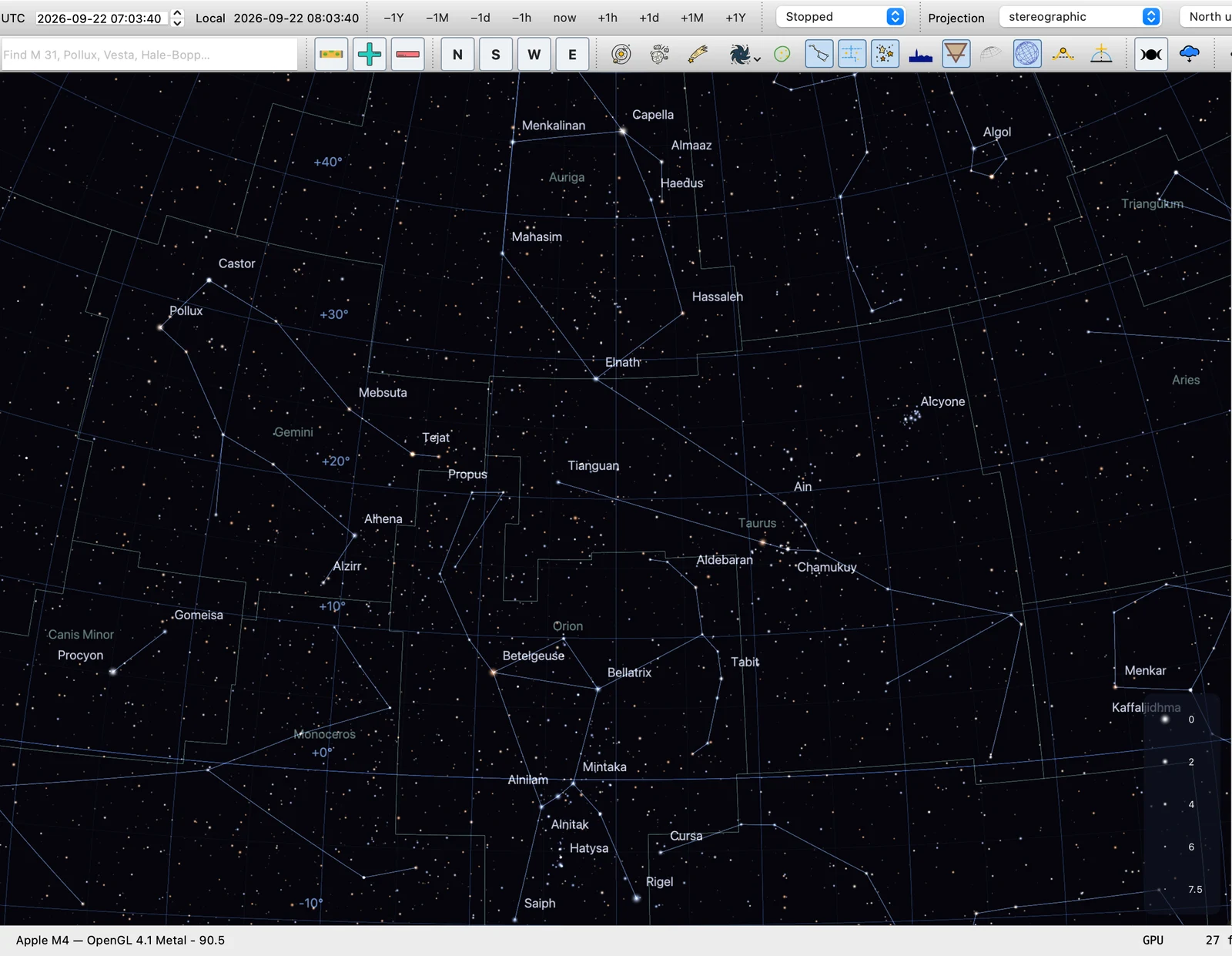
Sky42 showing Orion, Taurus and Gemini with star names, constellation figures, boundaries and the equatorial grid
🛰️ Sky42 1.0 is here. Freeware for non-commercial use — no account, no subscription, no license key. See the terms for what non-commercial means and how the data licenses travel with it.

What's on the chart

Every layer below is built from a named, cited catalogue — not a texture or an approximation.

Gaia DR3

Over a billion stars, complete to magnitude 20

The star field is ESA's Gaia Data Release 3, down to G = 20: 1,060,293,402 stars, each with its position, parallax, proper motion and colour. The count isn't estimated — it matches the Gaia archive's own count for G < 20, star for star. Click any of them and the inspector gives you its Gaia identifier, G magnitude, BP−RP colour, distance and proper motion.

  • Split into magnitude tiers, so you download only the depth you need: the whole sky to G 9 is 11 MB, the full depth to G 20 about 64 GB. The catalogue manager fetches each tier when you ask for it, and a download that is interrupted picks up where it stopped.
  • The packs are read straight from disk, not copied into memory: a 3.6′ field in a crowded part of the Milky Way, down to magnitude 17.5, draws 1,327 stars in 0.25 ms.
Gaia DR3G < 20Parallax & proper motionTiered download
Navigation & rendering

Continuous pan and zoom, from all-sky to telescopic

Four projections, configurable time and observer, live coordinates under the cursor, and a frame counter that keeps the frame cost honest as catalogues grow. Click a star or a deep sky object to select it and read it in the inspector; search finds it by name.

  • Switchable equatorial and altazimuth grids over a drawn horizon, with the ground filled in below it and the cardinal points named on it.
  • Two rasterisers behind one seam: OpenGL where a 3.3 Core context can be had, NumPy and QImage where it cannot. The choice is automatic, --renderer overrides it, and the status bar says which one is drawing.
4 projectionsOpenGL / CPU fallback
Deep sky

The Messier, NGC and IC objects, and 971,205 galaxies underneath them

The deep sky is two layers, drawn as chart symbols: OpenNGC's Messier, NGC and IC objects, and HYPERLEDA's galaxies below them. Conspicuous nebulae also show their traced shape — 238 closed outlines over 171 objects from OpenNGC, drawn where a ring is at least twelve pixels across, because the catalogue ellipse that suits a galaxy is a circle around a filament for the Veil.

OpenNGCHYPERLEDA I238 traced outlines
Solar system

The Sun, the Moon and the eight planets, from JPL DE440s

Named on the chart and readable in the inspector with their magnitude, elongation, phase angle and light time. DE440s covers 1849 to 2150; outside that interval Sky42 draws no bodies rather than extrapolating.

DE440sMagnitudePhase angleLight time
Stars & constellations

88 constellation boundaries, and figures that join real stars

The 88 constellation boundaries are drawn from Delporte's B1875 definition, sampled as the curves they are. The naked eye stars come from the Bright Star Catalogue with their proper names and Bayer designations — Gaia does not have the bright stars, twelve of the fourteen brightest in the sky are absent from it — and the constellation figures join those stars rather than tracing coordinates.

Bright Star CatalogueDelporte B1875d3-celestial figures
Coordinate systems

Astrometric, apparent, and observed — three coherent modes

The chart representation covers astrometric ICRS, apparent CIRS of date, and observed place including atmospheric refraction. A separate readout selector lets the cursor and inspector use a different system — for example, an observed chart with catalogue-comparable ICRS right ascension and declination. Apparent CIRS remains the chart default; ICRS remains the numeric default.

ICRSCIRSRefraction
Minor planets

1,563,075 asteroids, propagated the way the field of view asks for

Minor planets use MPCORB elements, conservative light-time/parallax screening, H-G photometry and an inspector showing orbital epoch and quality. The default --asteroid-dynamics auto uses fast two-body propagation on wide charts and switches to perturbed ASSIST/IAS15 trajectories when the whole viewport falls below one square degree; kepler and assist remain explicit overrides.

MPCORBH-G photometryASSIST / IAS15
Comets

One universal-variable solver, no threshold on eccentricity

Comets come from the MPC's CometEls with the same observed-place chain, but a solver and a photometry of their own: one universal-variable conic covers the ellipses, the 244 near-parabolic orbits, and the hyperbolic ones. Brightness follows the MPC's M1/K1 total-magnitude model rather than the asteroids' H-G phase law. A comet with no published photometry is drawn and says its magnitude is unknown, instead of silently disappearing.

CometElsM1/K1 photometry
Search & selection

Search covers all of it — and says so when a name is ambiguous

The deep sky, the naked eye stars by proper name, Bayer, Flamsteed, HR, HD and HIP, every minor planet by number, name or provisional designation, and the comets. When a name belongs to more than one object — Halley is a minor planet and a comet — the matches are listed instead of counted. Whatever is selected is marked on the chart by four ticks around it, even when it is too faint for the field to draw it: the ticks say the thing is here, without putting a light where there is none.

Cross-catalogue searchSelection reticle
Staying current

Orbital elements refresh atomically, and the app checks itself

Orbital elements can be refreshed from the toolbar or the command line: Sky42 asks the Minor Planet Center whether its files are newer than yours, downloads and rebuilds on a worker thread, and replaces each pack atomically — a cancelled or failed update leaves the previous catalogue byte for byte as it was. The ⋯ menu holds what isn't a layer: the ephemeris table, About Sky42, and Check for Updates, which asks the Sky42 site whether a newer version has been published. Sky42 downloads and installs nothing — the button opens the download page. The same check runs silently at most once a week and speaks only when there's something to say.

Atomic replaceWeekly, silent check

From the deep field to the asteroid belt

Unretouched captures from the running app, on Windows and macOS.

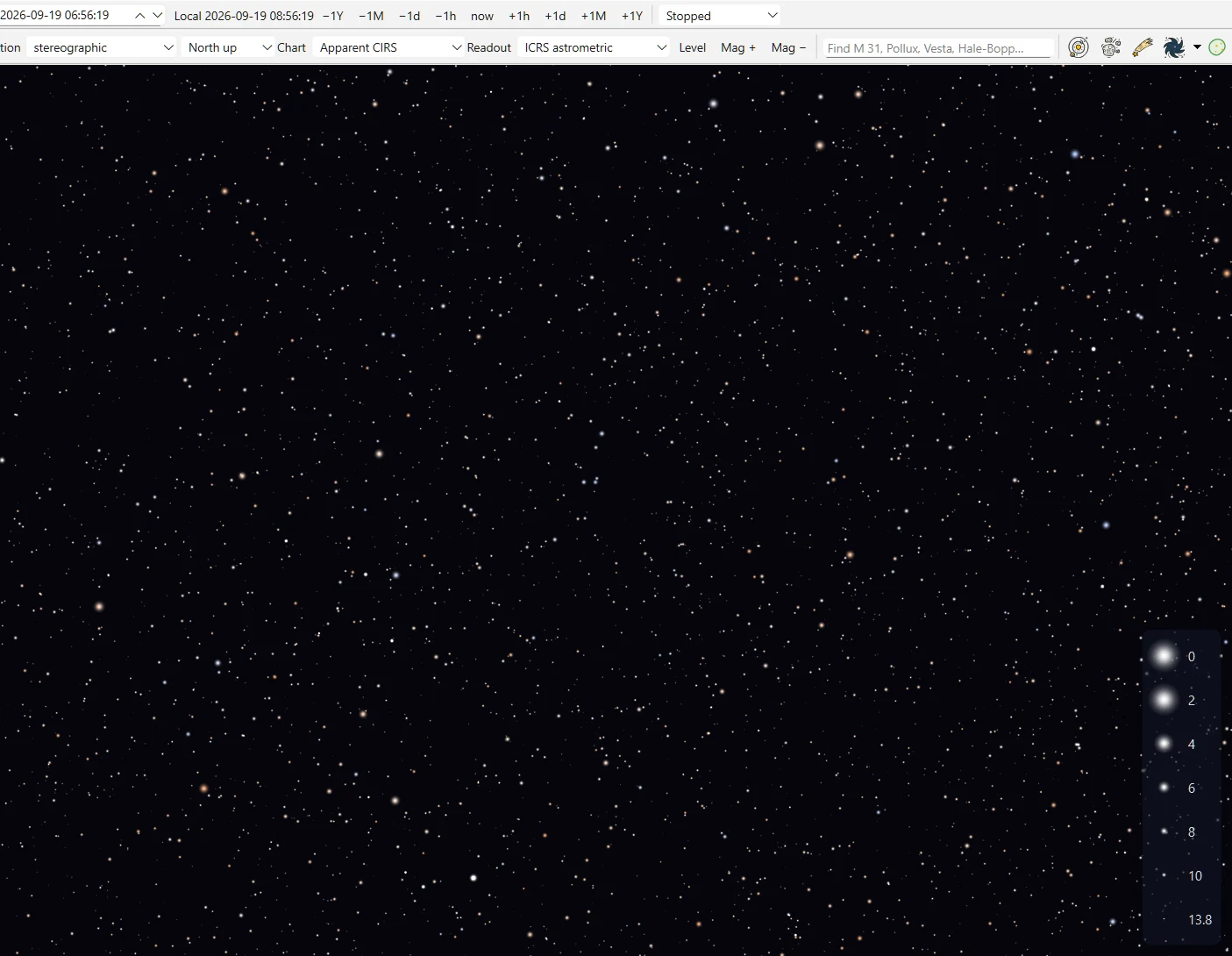
Sky42 showing a 3-degree Gaia DR3 star field drawn down to magnitude 13.8
Gaia DR3 in a 3° field — 4,812 stars drawn down to magnitude 13.8, coloured by their BP−RP index.
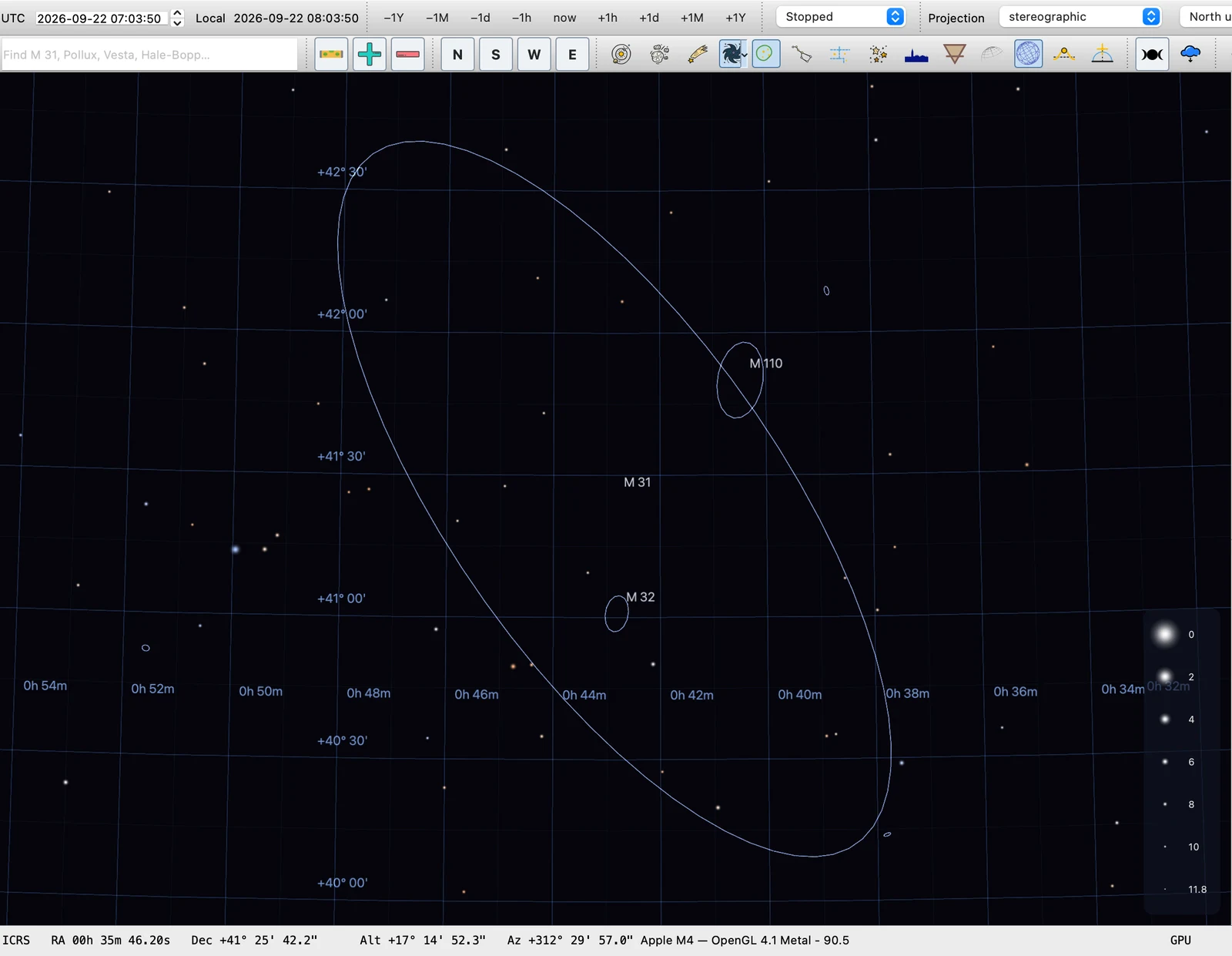
Sky42 zoomed into the Andromeda Galaxy showing M31, M32 and M110 with OpenNGC ellipses
Deep sky at 3° — M31, M32 and M110 drawn from OpenNGC, with the equatorial grid for scale.
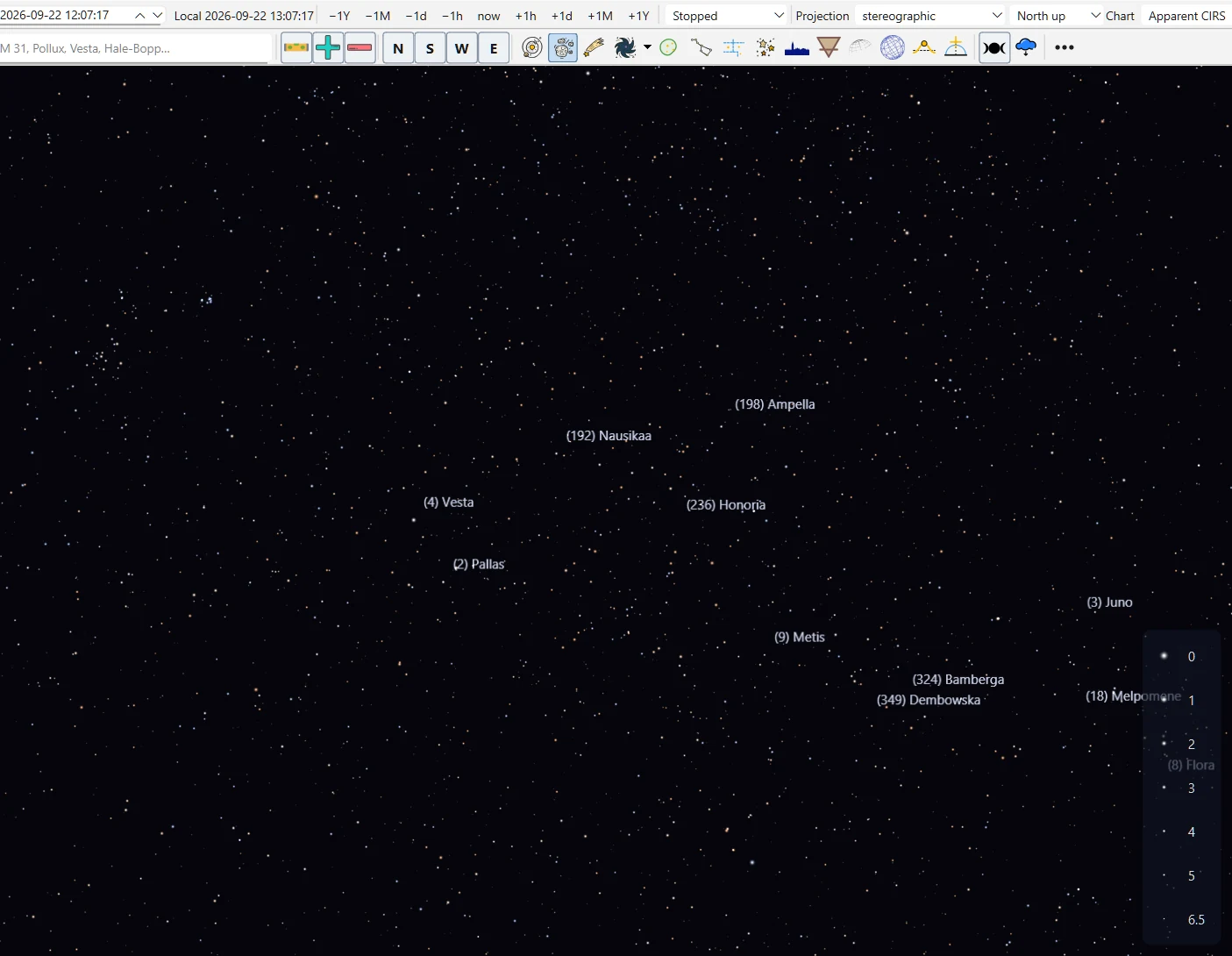
Sky42 showing Vesta, Pallas, Juno and other numbered minor planets labelled against the star field
Minor planets — Vesta, Pallas, Juno and their neighbours, placed from MPCORB elements for the chosen date.
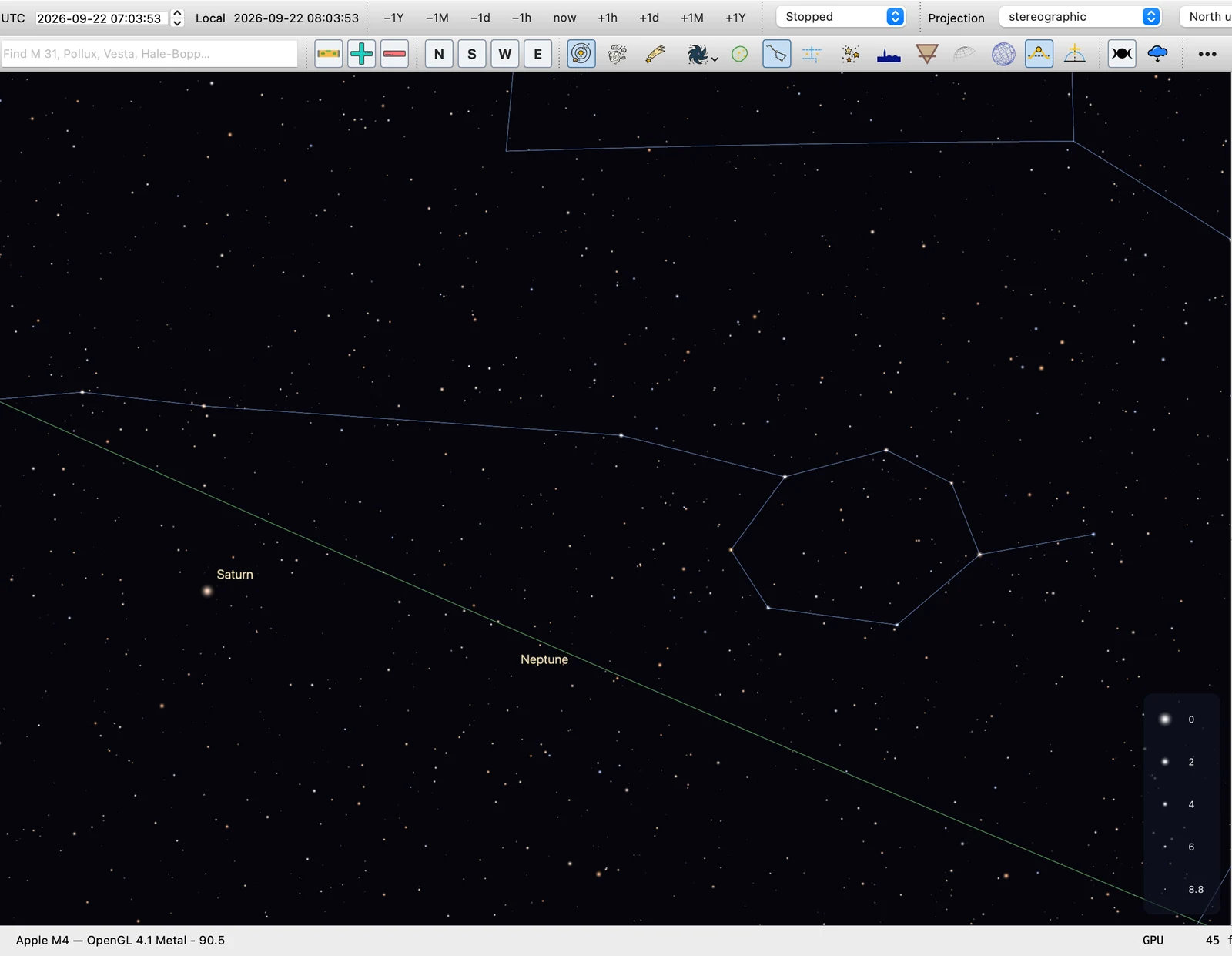
Sky42 showing Saturn and Neptune near Capricornus with the ecliptic line
Solar system layer — Saturn and Neptune placed against Capricornus, with the ecliptic drawn in.

Every layer is a cited source

Attribution travels with the data: every catalogue Sky42 downloads arrives with its own ATTRIBUTION.txt beside it, carrying the credit and the citation its authors ask for.

Stars — Gaia DR3 European Space Agency mission Gaia, processed by the Gaia Data Processing and Analysis Consortium (DPAC). Gaia Collaboration, Prusti et al., A&A 595, A1, 2016; Vallenari et al., A&A 674, A1, 2023. Credit: ESA/Gaia/DPAC
Deep sky — OpenNGC By Mattia Verga. The nebula outlines are OpenNGC's own too, traced by hand over DSS2 Color imagery with Aladin at CDS Strasbourg. CC-BY-SA-4.0
Galaxies — HYPERLEDA I Paturel et al., A&A 412, 45, 2003, via VizieR VII/237. Asks to be cited rather than licensed. Citation requested
More deep sky — via VizieR Barnard's 349 dark nebulae (1927, VizieR VII/220A); Sharpless's HII regions (ApJS 4, 257, 1959, VizieR VII/20); open clusters from Dias et al. (A&A 389, 871, 2002, v3.5, VizieR B/ocl). Citation requested
Constellation boundaries VizieR VI/49 (Davenhall & Leggett, Royal Observatory Edinburgh, 1989), from the boundaries E. Delporte fixed for the IAU in 1930.
Bright stars Bright Star Catalogue, 5th Rev. Ed. (Hoffleit & Warren, 1991, VizieR V/50); Hipparcos cross-index (Kostjuk, 2002, VizieR IV/27A); proper names from the IAU Catalog of Star Names. CC-BY (names)
Constellation figures — d3-celestial By Olaf Frohn. Chosen over Stellarium's after measuring both: 743 segments against 844, the same 88 constellations, no share-alike on the data. BSD-3-Clause
Ephemeris — JPL DE440s Park, Folkner, Williams & Boggs, AJ 161:105, 2021. Produced by the Jet Propulsion Laboratory; covers 1849–2150.
Minor planets & comets MPCORB and CometEls from the Minor Planet Center, a service of the IAU hosted by the Smithsonian Astrophysical Observatory. MPC use guidelines
Observing places 2,690 MPC observatory codes; 34,140 GeoNames cities15000 towns with IANA time zones; Natural Earth 1:110m coastlines. CC-BY-4.0 / public domain
Drag, wheel, click — and a key per layer

Drag to pan, wheel to zoom on the cursor, click to select, double click to centre, arrow keys to step.

HorizonH
Alt-az gridA
Equatorial gridE
GroundG
Deep sky objectsD
Solar systemP
Minor planetsM
CometsK
Constellation boundariesB
FiguresF
Nebula outlinesO
Named naked eye starsN

Release history

Sky42 1.0 is the first public release. From here on, every version is listed with what it adds, changes and fixes.

Loading…

Free, standalone, and yours to keep

Sky42 1.0 is freeware for non-commercial use — for Windows and macOS, no account, no subscription, and nothing that stops working when you're offline.

Download Sky42
Version 1.0.0  ·  Windows & macOS